
ECOPER was commissioned by the UNESCO Internal Oversight Services to conduct the evaluation of the International Center for Theoretical Physics (ICTP).
Under the umbrella of the UNESCO Natural Sciences Sector, ICTP is a UNESCO Category 1 Center governed by a tripartite agreement between the government of Italy, the International Atomic Energy Agency (IAEA), and UNESCO. The mission of ICTP rests on three equally important foundational pillars:
- conducting world-class research in frontier areas of science,
- scientific capacity-building in the developing world especially, through advanced study opportunities and training with the aim of bridging the North-South knowledge divide,
- and providing science advocacy and international cooperation through science.
Since its last evaluation in 2011, ICTP has expanded the thematic scope of its activities to areas such as quantum computing and medical physics, while maintaining its commitment to theoretical physics. 2024 also marked the 60th anniversary of ICTP’s founding by Abdus Salam. The current evaluation covered the period 2012-2024 and aimed to provide systematic evidence about what has worked, what has not worked and why, and to identify areas of improvement for ICTP.
A mixed-methods approach was employed to ensure a comprehensive and reliable evaluation. This included a desk review of ICTP documents, two field missions to ICTP in Trieste, semi-structured interviews, focus group discussions, and an online tracer study targeting all ICTP students and fellows since 2012. The tracer study, supported by the online platform Alchemer, gathered responses from 527 participants, yielding a 40% response rate providing a broad and participatory evidence base.
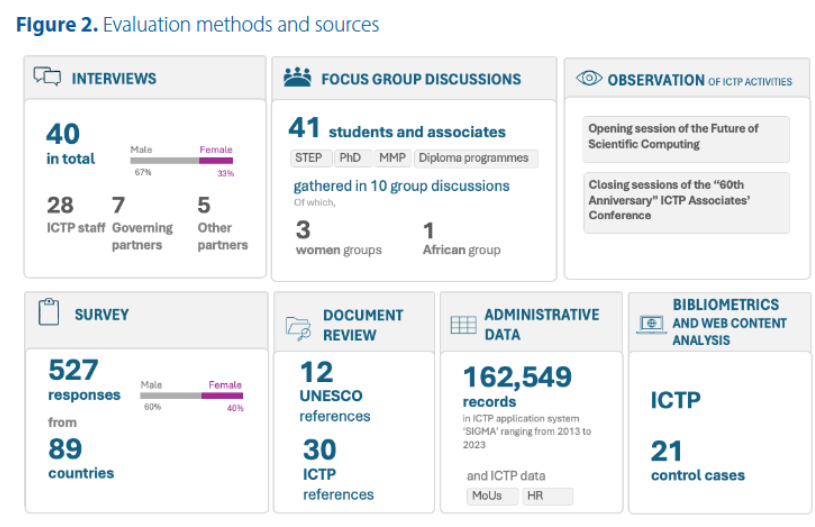
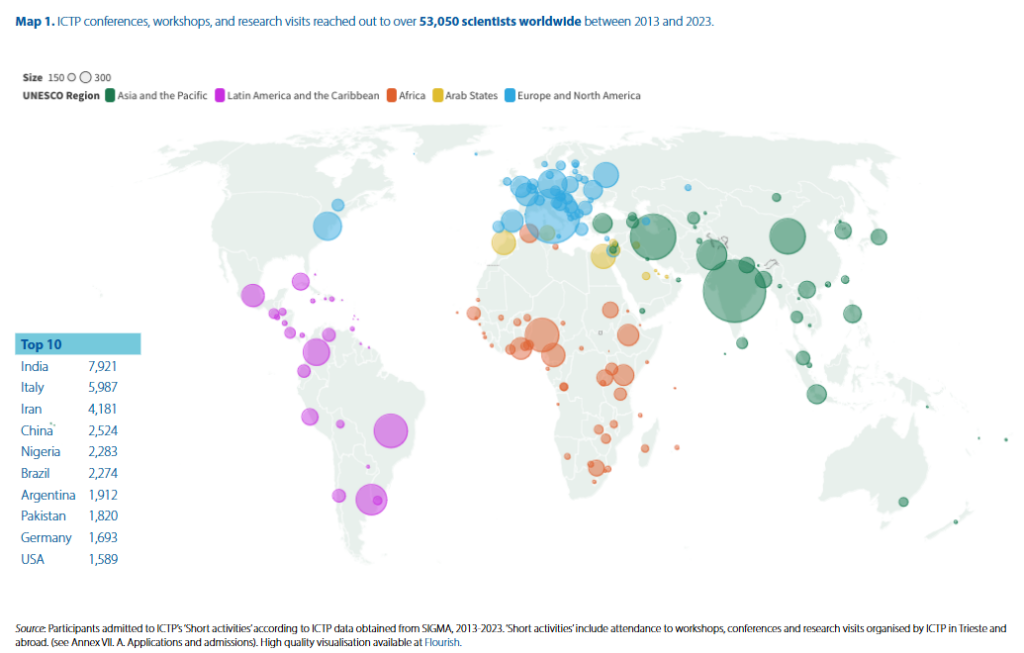
Innovative techniques were comnined with traditional programme evaluation methods, including bibliometric analysis and web content analysis with big data techniques. Additionally, geographic visualization of ICTP outreach and impact was achieved using Flourish, as shown in hte following map.
The evaluation team, led by Dr. Aitor Pérez, included experts such as Dr. Diego Blas, a theoretical physics expert, Dr. Martiño Rubal, an education sector expert, and Ms. Flavia Fernández, the quality controller. Their combined expertise ensured a thorough and insightful evaluation process, guided by the principles of the United Nations Evaluation Group (UNEG) and UNESCO guidelines. The team’s diverse backgrounds and extensive experience in evaluation and research contributed significantly to the depth and quality of the evaluation findings and recommendations.