
Investment Support Programme for Least Developed Countries (ISP/LDC) provides technical and legal assistance, as well as complementary capacity building to LDC governments and private sector entities on investment-related matters, including negotiations and dispute settlement. Assistance under ISP/LDCs is provided at no cost to the beneficiaries, by harnessing the expertise of lawyers and experts working on a “pro bono” or reduced fee basis. ISP/LDCs was developed by IDLO in cooperation with the UN Office of the High Representative for the Least Developed Countries, Landlocked Developing Countries and Small Islands Developing States. It is funded by the European Union and the Kuwait Fund for Arab Economic Development.
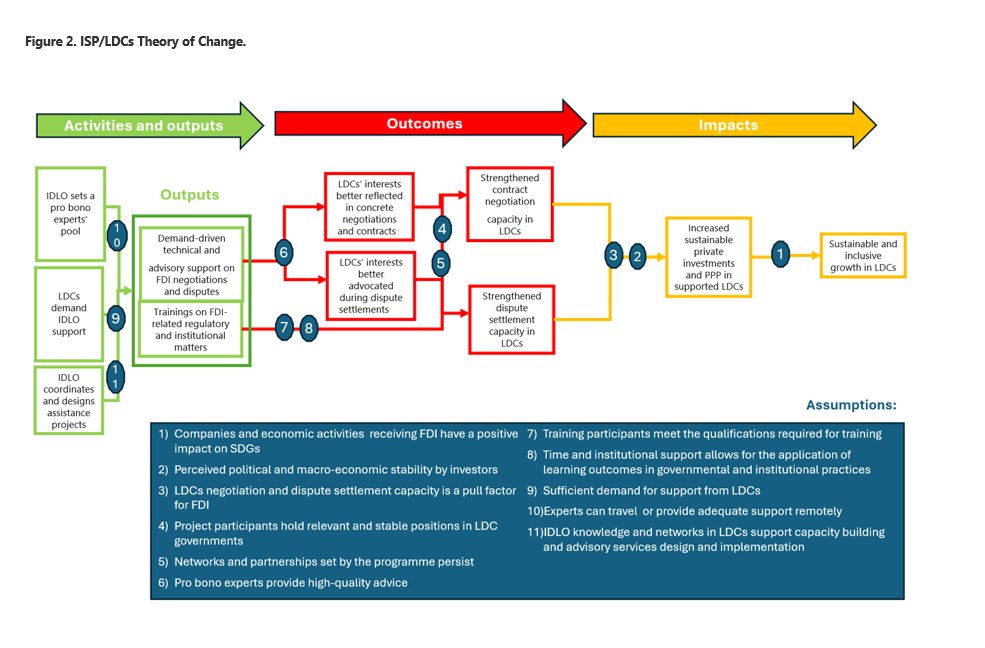
The final evaluation of this project was commissioned by IDLO to Aitor Perez, lead evaluator and Chief Consultant at ECOPER and Fiorina Mugione, foreign investment expert. The evaluation report briefly explains the background and results framework of the intervention (Section 2), including a diagram that outlines the reconstructed Theory of Change (ToC) and its underlying assumptions. It also categorises project stakeholders to inform the evaluation strategy.
The evaluation of the IDLO Investment Support Programme for Least Developed Countries (ISP/LDCs) employed a mixed-methods approach to gather comprehensive insights into the programme’s effectiveness, relevance, and impact. The methodology combined both qualitative and quantitative data collection and analysis techniques. The primary methods included a thorough document review, which involved analyzing various programme documents such as action plans, progress reports, and project-specific documents to extract relevant findings related to the programme’s implementation and context. This was complemented by data analysis, where quantitative data from programme records were extracted and analyzed to develop indicators that helped assess the programme’s effectiveness and impact quantitatively.
In addition to document review and data analysis, the evaluation team conducted semi-structured interviews with key stakeholders, including IDLO staff, experts, and LDC focal points. These interviews provided detailed qualitative insights into personal experiences, perceptions, and outcomes related to the programme. An online survey was also conducted using the Alchemer platform to gather feedback from various stakeholders, including trainees and experts, on different aspects of the programme. Although focus group discussions were initially planned to assess the effectiveness and sustainability of partnerships, they were later integrated into the interviews due to low response rates and time constraints. This comprehensive approach allowed the evaluators to triangulate information from different methods and data sources, ensuring a robust and well-rounded evaluation of the ISP/LDCs programme.