
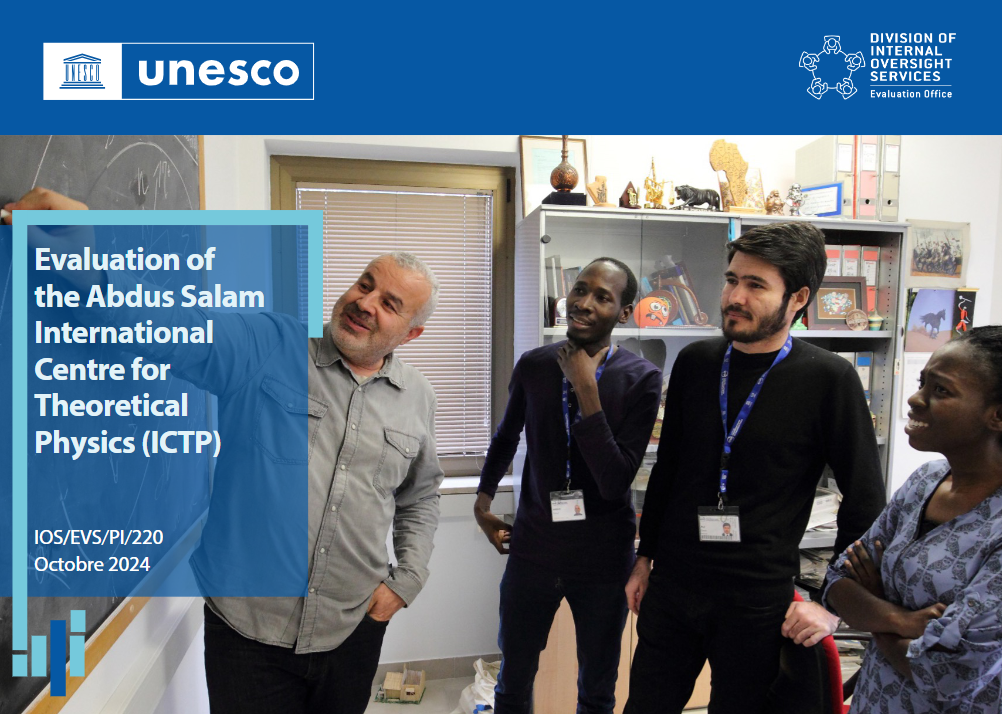
In october of 2024, UNESCO published The evaluation of the Abdus Salam International Centre for Theoretical Physics (ICTP) which was conducted by ECOPER.
The report reveals taht ICTP’s mission and foundational principles of excellence, inclusion, and international cooperation remain highly relevant to the needs of developing countries, addressing the persistent North-South capacity gap and new technological challenges and opportunities. The evaluation found ICTP’s model and construct to have proven successful overtime. Key findings of the report include a comprehensive measurement and mapping of ICTP outreach and impact across developing countries.
Capacity-building of scientists in the developing world
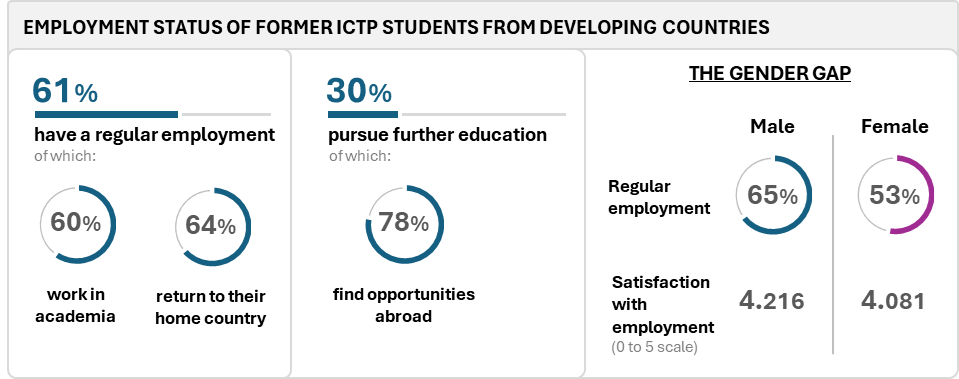
Although ICTP’s primary function is to foster fundamental science, which enables long-term technological progress, the Centre’s impact on advancing scientists’ careers in developing countries is significant. Indeed, ICTP is inclusive and levels the playing field in science by targeting and training young scientists from these regions especially. Besides addressing geographic barriers, ICTP is consistently mindful of other barriers that hinder access to scientific research, including gender inequalities. The increasing number of applications from women and African scientists over time exemplifies ICTP’s alignment with UNESCO’s Global Priorities, with each category representing 1 in 4 applicants in 2023. ICTP’s educational and career development programs are highly regarded by participants, with students from the global South increasingly motivated to apply due to their scientific excellence, the high quality of teaching and ICTP’s international dimension. Former students and associates consistently rate their satisfaction above 4.5 on a scale of 0 to 5. This satisfaction spans across gender and income groups. With as many as 64% of former ICTP students surveyed indicating they had returned to their home countries after completing their training, ICTP has helped counteract brain drain and strengthen capacities at the country-level.
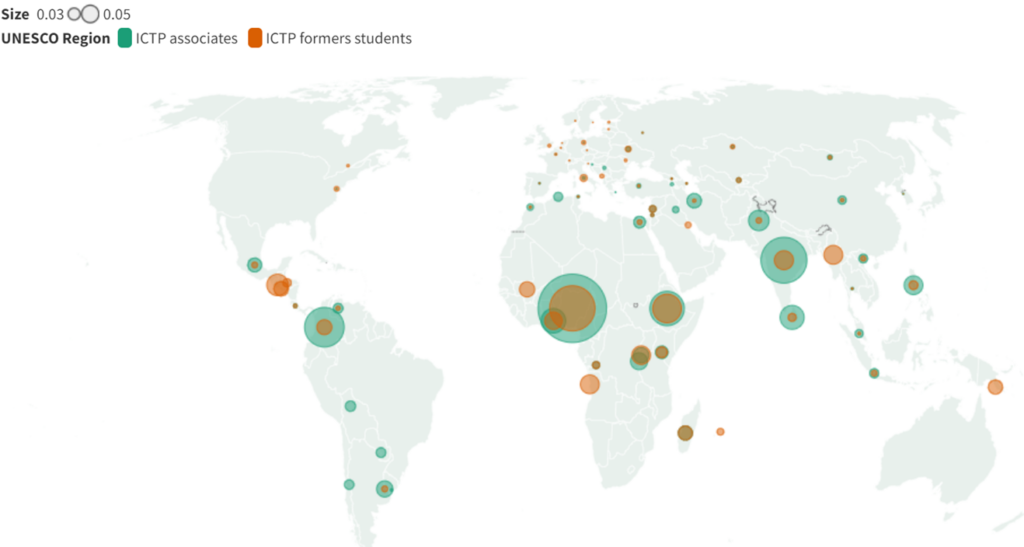
The report contains several maps showing the outreach and impact of ICTP across developing countries, including the following map, showing the impact of ICTP returned scientists on developing countries scientific capacities. These findings have positioned ICTP as a model to tackle brain drain and contribute to SDG target 9.5: ““build resilient infrastructure, promote inclusive and sustainable industrialization and foster innovation”.
Mapping of ICTP impact: returned trained scientists over the number of researchers per million of inhabitants
Conducting world-class research in frontier areas of science
ICTP is considered a world class research institution by the plurality of informants consulted. This finding is supported by the bibliometric analysis performed during the evaluation, which determined ICTP to have a very high published paper-citation ratio, comparable to other world-class research institutions such as CERN. This highlights the quality of research produced at ICTP. Figure 1: Bibliometrics confirm ICTP’s scientific excellence Desk Review + Bibliometric Analysis comparing ICTP to 21 institutes
International Cooperation and Advocacy
ICTP’s network extends through Partner Institutes, Affiliated Centres, and other collaborations, which contribute to developing scientific communities across the globe. The Senior Associates Programme has been particularly effective in establishing long-term partnerships with scientists from developing countries, providing support to combat scientific isolation and enhance local research capabilities. In addition, ICTP’s extensive network of conferences, workshops, and research visits facilitates scientific exchange worldwide.
Nonetheless, the evaluation found that the advocacy component of ICTP’s mission remains somewhat underdeveloped. Although ICTP engages in some ad hoc science diplomacy efforts that influence governmental and educational policies, this advocacy aspect lacks a precise framework and clear objectives, indicating room for strategic improvement.
ICTP’s efficiency and sustainability
To sustain and potentially expand activities, ICTP is exploring ways to diversify its funding sources, ensuring that high-quality research, training, and capacity-building continue without disruption. Although the Centre enjoys a stable level of core funding, mainly provided by the Government of Italy, it remains sensitive to rising inflation. As ICTP has grown, increased administrative demands have stretched the Centre’s limited staff resources, particularly in support of activities in the Global South. While efficiency measures have been introduced, additional strategic efficiencies could further support ICTP’s vision. New funding sources will ensure ICTP is able to continue expanding into emerging areas of study to remain on the frontier of global science as envisioned by its founder Abdus Salam.
The way forward
The evaluation report includes three actionable recommendations for ICTP:
- ICTP should set a localisation plan aimed at deploying an increasing number of activities in the Global South, with a focus on underrepresented regions: To achieve this, ICTP should first assess the costs and benefits of its various network modalities, including Partner Institutes, Affiliated Centres, research networks, and the Senior Associates Programme.
- ICTP should enhance its strategic planning and monitoring by systematically measuring the impact of its educational and career development programmes on developing countries: Collecting metrics would enhance ICTP’s capacity to measure its impact, showcase its achievements, and identify gaps where it could further invest its efforts.
- ICTP and the UNESCO Natural Sciences Sector should refine ICTP’s third pillar on international cooperation and advocacy: Such clarification should include a definition of the different roles that ICTP, UNESCO Headquarters, and Field Offices play, as well as areas for potential collaboration and synergies.