Evaluating the World Academy of Sciences’ support to sustainability science in LDCs

The World Academy of Sciences (TWAS), founded in 1983, is an international organization dedicated to promoting scientific capacity and excellence for sustainable development in the developing world. As a programme unit of UNESCO, TWAS supports research, provides fellowships, and encourages collaboration among scientists in the global South. With its headquarters at the International Center for …

Read more

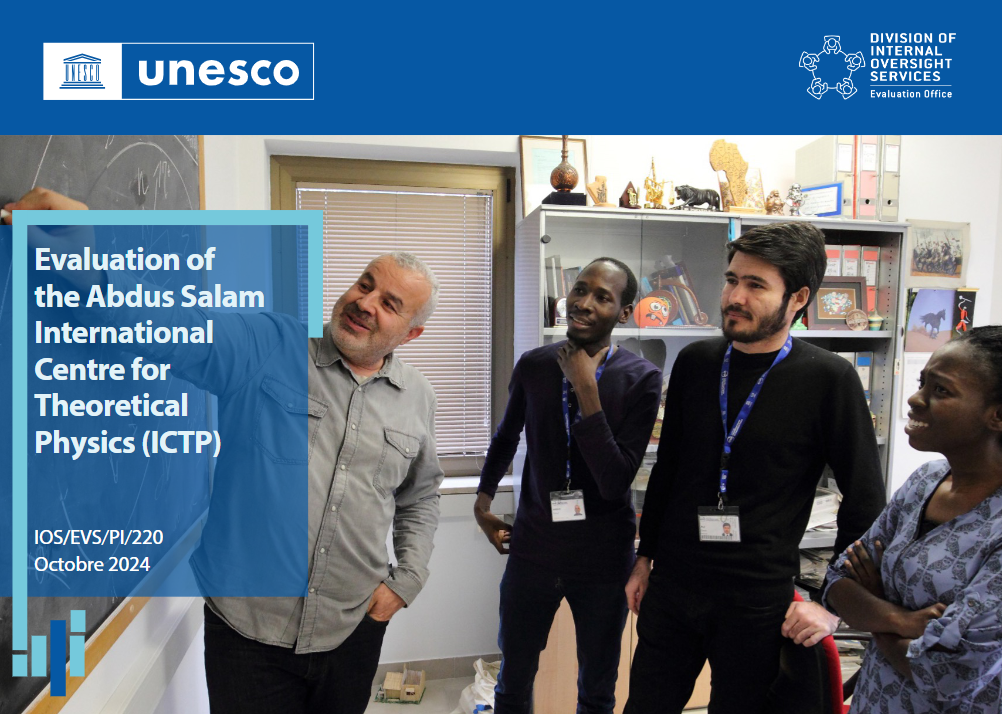
ICTP Evaluation Published by UNESCO

In october of 2024, UNESCO published The evaluation of the Abdus Salam International Centre for Theoretical Physics (ICTP) which was conducted by ECOPER.

The report reveals taht ICTP’s mission and foundational principles of excellence, inclusion, and international cooperation remain highly relevant to the needs of developing countries, addressing the persistent North-South capacity gap and new technological challenges and opportunities. The evaluation found ICTP’s model and construct to have proven successful overtime. Key findings of the report include a comprehensive measurement and mapping of ICTP outreach and impact across developing countries.

Read more

Evaluation of the IDLO Investment Support Programme for Least Developed Countries (ISP/LDCs)

Investment Support Programme for Least Developed Countries (ISP/LDC) provides technical and legal assistance, as well as complementary capacity building to LDC governments and private sector entities on investment-related matters, including negotiations and dispute settlement. Assistance under ISP/LDCs is provided at no cost to the beneficiaries, by harnessing the expertise of lawyers and experts working on …

Read more

The scrutiny of EU-funded investments in developing countries

In June 2024, the Trans European Policy Studies Association (TEPSA) published a policy brief by ECOPER chief consultant Aitor Perez. It discusses the scrutiny of EU-funded investments in developing countries, focusing on the European Fund for Sustainable Development Plus (EFSD+) and its role in bridging the financing gap for achieving the Sustainable Development Goals (SDGs). …

Read more

West Africa: regional trade and integration in global value chains

West Africa faces significant trade challenges, including aging infrastructure, inefficient customs processes, and high logistics costs that hinder regional and international trade. The high transport delays and costs, as well as non-tariff barriers, limit their competitiveness in global markets. Against this backdrop, UNCTAD has conducted a technical cooperation project and assigned to ECOPER its final …

Read more

Evaluating ICTP, the UNESCO category 1 center on natural sciences

ECOPER was commissioned by the UNESCO Internal Oversight Services to conduct the evaluation of the International Center for Theoretical Physics (ICTP). Under the umbrella of the UNESCO Natural Sciences Sector, ICTP is a UNESCO Category 1 Center governed by a tripartite agreement between the government of Italy, the International Atomic Energy Agency (IAEA), and UNESCO. …

Read more

Evaluation of a new literacy institution in Morocco

UNESCO has commissioned the evaluation of the EU funded project to set up the Institute for Training in Literacy Professions (IFMA) to ECOPER. IFMA provides training programs aimed at equipping educators and facilitators with the necessary skills to teach literacy effectively. IFMA plays a crucial role in developing educational materials and methodologies tailored to local …

Read more

UNESCO’s board discusses ECOPER’s report on Creative Cities

The UNESCO Creative Cities Network (UCCN) was established in 2004 to foster international cooperation and knowledge exchange among cities that use culture and creativity as a driver for sustainable urban development. Since then, the Network has progressively increased its membership and currently covers 350 cities in more than 100 countries across the five UNESCO regions. …

Read more

Decentralized cooperation reaches all-time high

Publication of the Decentralised Cooperation Report 2023, a work by ECOPER for the Basque Agency for Development Cooperation. Decentralised Official Development Assistance (DODA) will grow by 14% in 2021, exceeding its historic ceiling of 3 billion dollars. These data are included in the Decentralised Cooperation Report 2023, along with other characteristics of international cooperation by …

Read more

Defining, estimating and disseminating statistics on illicit financial flows in Africa

UNCTAD published ECOPER’s evaluation report on UN Development Account project 1819Y on Defining, estimating and disseminating statistics on illicit financial flows in Africa. The project “Defining, Estimating, and Disseminating Statistics on Illicit Financial Flows (IFFs) in Africa” was designed to enhance the statistical capacity of African governments to measure and report on IFFs. This initiative …

Read more